By Shakiyla Huggins October 21, 2023

In the 21st century, the education landscape is rapidly evolving to meet the demands of an increasingly technology-driven world. The focus on Science, Technology, Engineering, and Mathematics (STEM) education has never been more critical. As we strive to nurture the next generation of innovators, educators and researchers are working tirelessly to enhance student motivation within STEM fields to bolster the STEM workforce.
The STEM Challenge
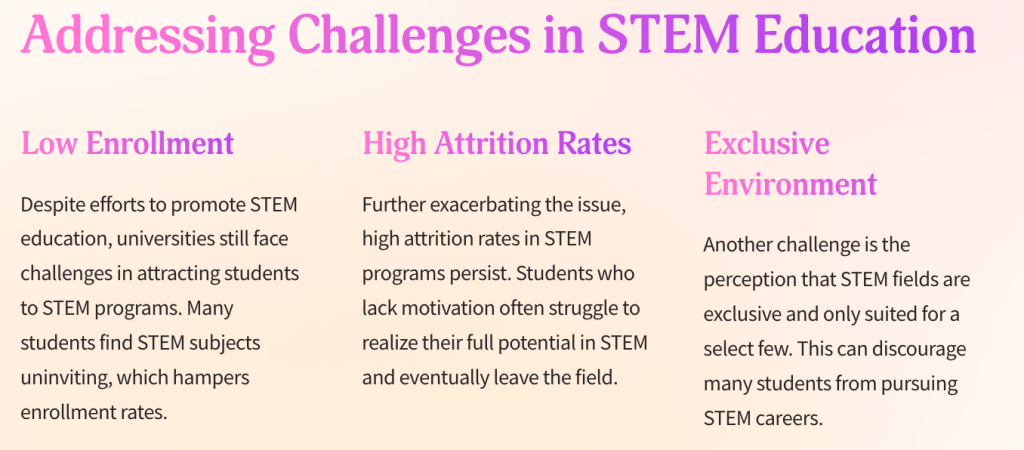
Back in 2012, President Obama’s Council of Advisors on Science and Technology (PCAST) recognized that less than 40% of students were entering college as STEM majors. Their ambitious plan aimed to increase the number of STEM majors by a million students over the next decade. This call to action highlights the urgency of preparing students for the scientific and technological advances of the future.
Yet, despite these efforts, universities continue to face challenges like low enrollment and high attrition rates in STEM programs7.
The Gamification Solution
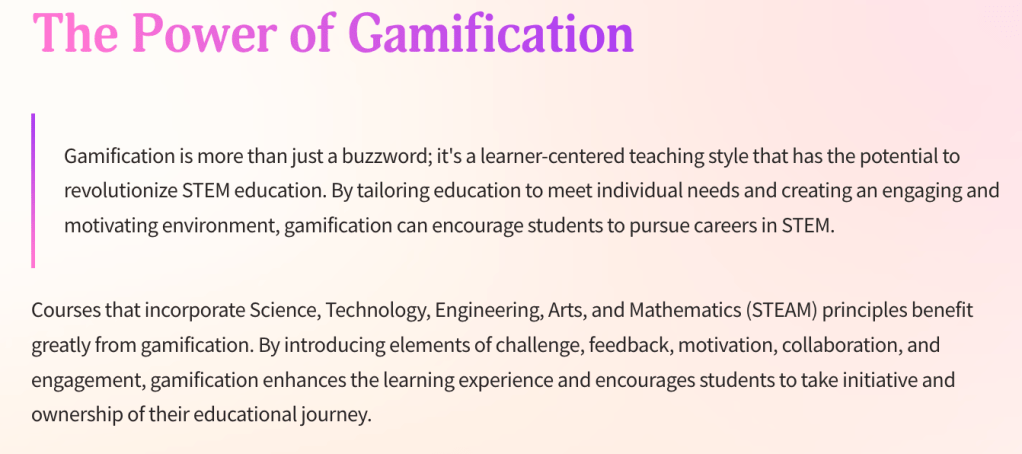
Enter gamification – a powerful approach that has the potential to revolutionize STEM education. Research suggests that gamification can create an engaging and motivating environment in STEM higher education, encouraging students to pursue undergraduate and graduate careers in these fields6.
The Self-Determination Theory
But, to truly understand why gamification works, we need a solid theoretical foundation. That’s where the Self-Determination Theory comes into play. This macro theory explores human motivation, emphasizing the importance of autonomy, competence, and relatedness in driving self-determined behavior2;5.
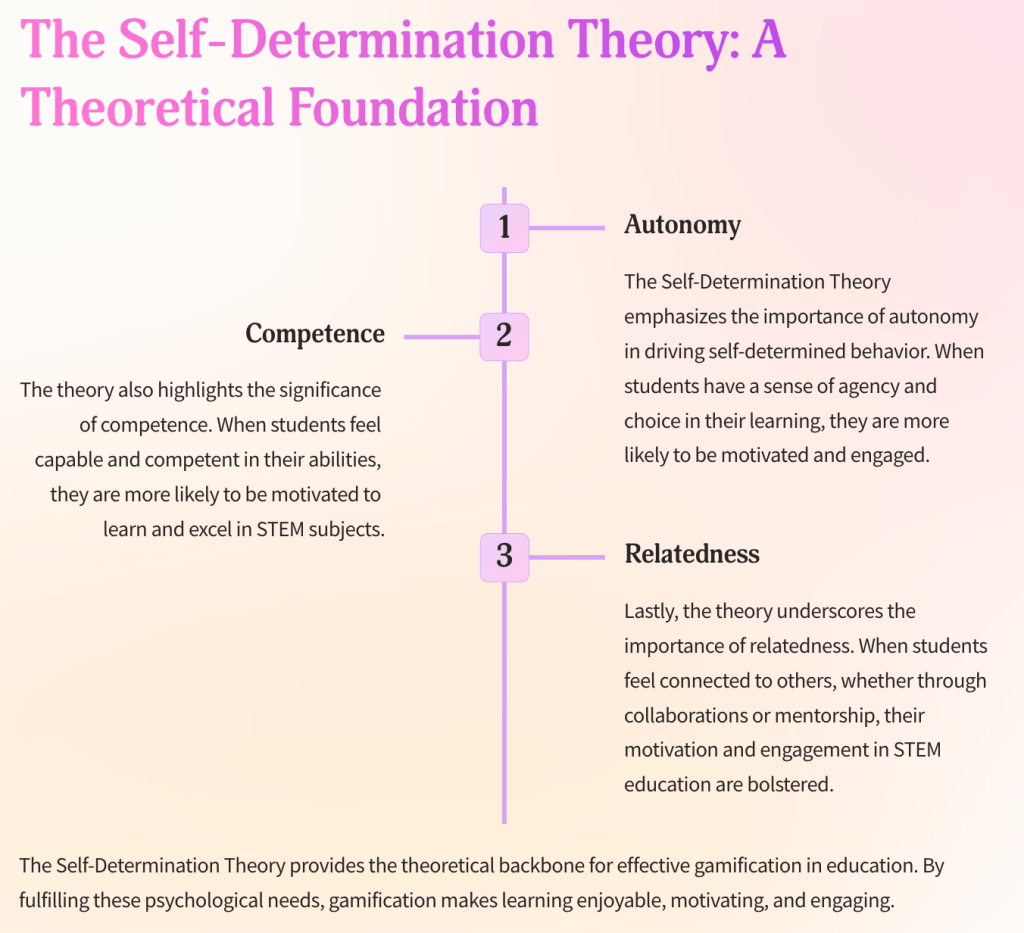
While the potential of gamification in STEM education is evident, it’s essential to explore its effects more deeply. How does it influence student motivation, as measured by the Self-Determination Theory? This question is at the heart of the work I’m engaged in.
About the Author
As a Learning Experience Designer with extensive experience in STEM education and instructional design, I’m passionate about unlocking the true potential of gamification to enhance motivation in STEM. Join me on this journey as we delve into the intricate world of gamification, motivation, and self-determination in STEM education.
Conclusion
I look forward to sharing insights, research findings, and practical applications that can change the way we approach STEM learning. Together, let’s embark on a mission to make STEM education more engaging, motivating, and accessible for all. Stay tuned for exciting discussions and discoveries that will shape the future of STEM education.
References
- Deci, E. L., & Ryan, R. M. (2000). The “What” and “Why” of Goal Pursuits: Human Needs and the Self-Determination of Behavior. Psychological Inquiry, 11, 227-268. Chinese Science Bulletin, 50(22), 227–268.
- Francisco-Aparicio, A., Gutiérrez-Vela, F. L., Isla-Montes, J. L., & Sanchez, J. L. G. (2013). Gamification: analysis and application. In New trends in interaction, virtual reality and modeling (pp. 113-126). Springer, London.
- Kapp, K. (2013, November 19). Gamification as Learner-Centered Instruction ” Karl Kapp. Retrieved from http://karlkapp.com/gamification-as-learner-centered-instruction/.
- López, P., Rodrigues-Silva, J., & Alsina, Á. (2021). Brazilian and Spanish mathematics teachers’ predispositions towards gamification in STEAM education. Education Sciences, 11(10). https://doi.org/10.3390/educsci11100618
- Niemiec, C. P., & Ryan, R. M. (2009). Autonomy, competence, and relatedness in the classroom: Applying self-determination theory to educational practice. Theory and Research in Education, 7(2), 133–144. https://doi.org/10.1177/1477878509104318
- Ortiz Rojas, M. E., Chiluiza, K., & Valcke, M. (2016). Gamification in higher education and stem: A systematic review of literature. In 8th International Conference on Education and New Learning Technologies (EDULEARN) (pp. 6548-6558). Iated-int Assoc Technology Education A& Development
- Sithole, A., Chiyaka, E. T., McCarthy, P., Mupinga, D. M., Bucklein, B. K., & Kibirige, J. (2017). Student attraction, persistence and retention in STEM programs: Successes and continuing challenges. Higher Education Studies, 7(1), 46-59.
 Gamifying your Designs Through Self-Determination
Leave a comment