By Shakiyla Huggins October 26, 2023

Gamification is more than just a buzzword; it’s a concept that’s transforming the way we approach education. It’s all about making learning fun, engaging, and motivating. In this blog post, we’ll delve into the world of gamification and explore how it’s changing the education landscape.
Defining Gamification
Let’s start with the basics. Gamification can be defined as
“the use of game design elements in non-game contexts.”
(Sailer et al., 2013, p. 29).
Essentially, it involves taking elements from games and applying them to situations that aren’t games. The goal? To engage, motivate, encourage desired behaviors, and enhance the overall user experience. Gamification isn’t limited to education; you’ll find it in corporate settings and various applications .
In the educational realm, gamification is a powerful tool. It’s not about replacing traditional instruction but enhancing it. Gamification has the potential to facilitate learning, boost motivation, improve interaction, and stimulate knowledge expansion.
Gamification vs. Gaming: Understanding the Difference
One common misconception is the tendency to confuse gamification with playing games. Although gamification may incorporate game elements, it’s vital to grasp the distinction between the two approaches.
Gaming: Gaming is an unpredictable model primarily designed for entertainment. It’s a world of complex narratives, stunning visual settings, and artificial conflicts that players engage with6. Data gathered from gaming generally reveals which aspects of the game users spend the most time on17.
Gamification: On the other hand, gamification is a strategic and predictable model. The outcomes are predefined before the gamified experience begins. The data collected in gamification serves a different purpose—it assesses and enhances the implementers of the model, providing detailed insights into each user’s behavior17.
Gamification vs. Game-Based Learning
Another common misconception is that gamification and game-based learning are the same. In reality, they have distinct purposes and approaches.
Game-Based Learning: Game-based learning employs game elements to teach specific skills or achieve specific learning outcomes. In this context, the game itself is where the learning takes place. These games are purposefully designed to educate and provide a structured environment for learners to develop particular skills4.
Gamification: Gamification, on the other hand, applies game mechanics in non-game contexts to promote desired behavior and drive learning outcomes. Instead of being the primary source of learning, gamification uses elements of a game as a reward system to encourage desired behaviors and enhance engagement4.
Content vs. Structural Gamification
Within the world of gamification, there are two primary types: content and structural gamification7. Content gamification focuses on altering the content within a gamified model. This means adding elements like stories, avatars, and challenges to make the content more game-like.
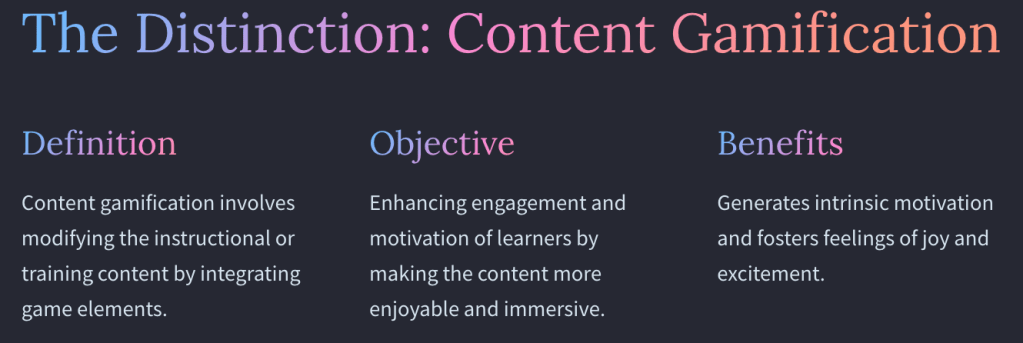
Structural gamification, however, keeps the content intact but modifies the structure around it. It’s more behavior-based and relies on reinforcements to encourage specific behaviors.

The Mediating and Moderating Process
In the world of gamification, it’s essential to understand how game elements affect learning. There are two processes at play: mediating and moderating10.
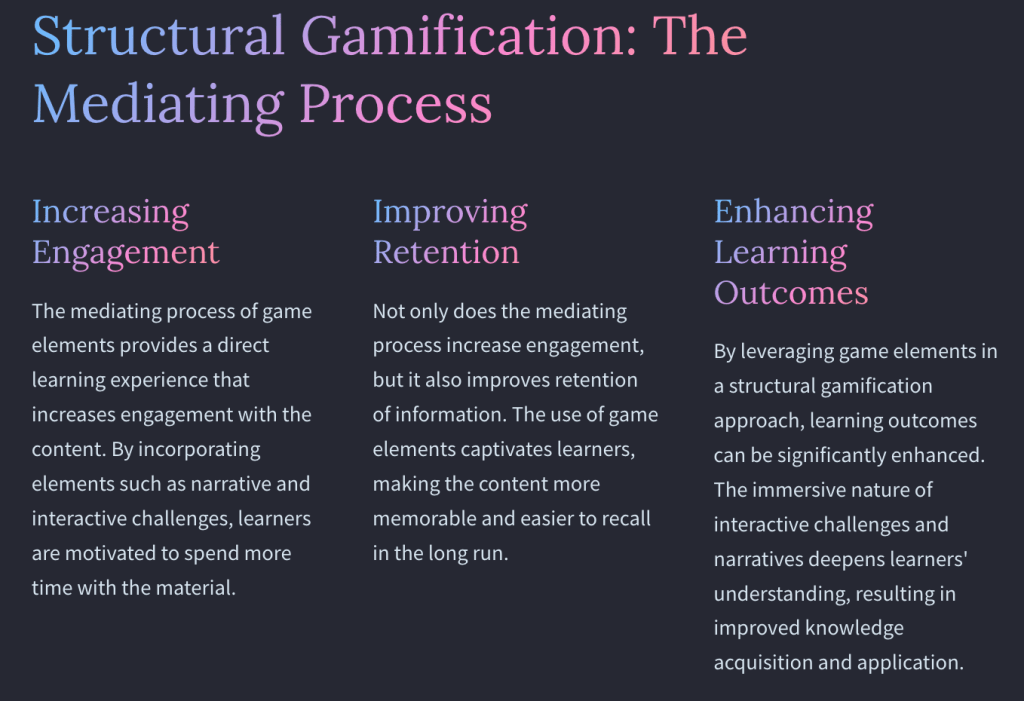
Mediating Process: This process is akin to structural gamification. It’s a more direct learning process that uses game elements like narratives to increase the time spent with content and improve learning outcomes. The game elements must cause the target behavior, which, in turn, leads to increased learning.
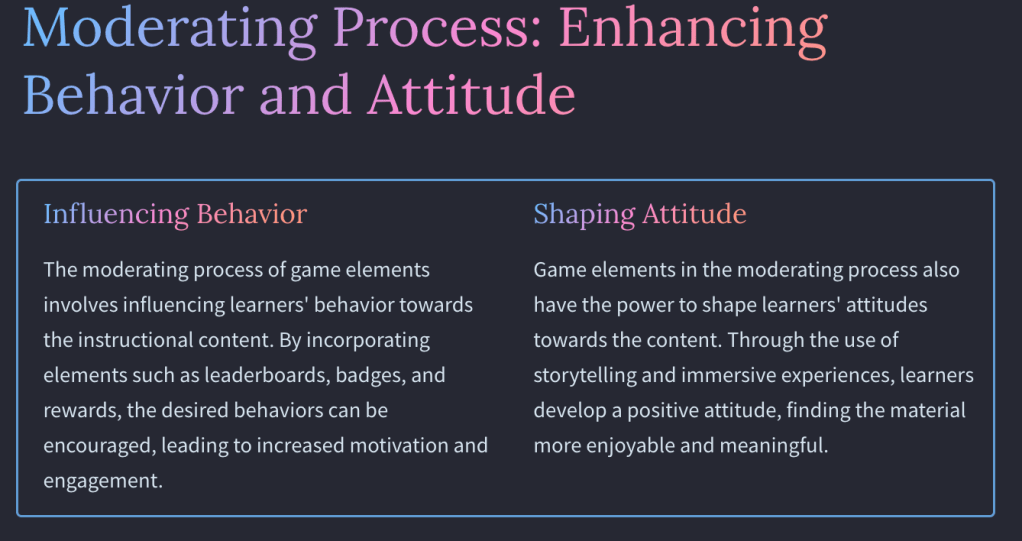
Moderating Process: In contrast, the moderating process is less direct. It influences behavior and attitudes towards instructional content and learning outcomes. Game elements are added to the content to boost motivation and encourage specific behaviors or attitudes that enhance learning.
It’s important to note that these two approaches aren’t mutually exclusive. In fact, they complement each other. Content gamification can generate intrinsic motivation, fostering feelings of autonomy, competence, and relatedness3. In contrast, structural gamification focuses on extrinsic motivation and reinforcements over longer periods3. When used in combination, they can create a well-rounded gamified design that caters to different motivational needs.
Game Elements in Gamification
The foundation of gamification lies in comprehending the fundamental elements of games and how they impact the learning process. Game elements can becategorized into two main groups: game dynamics and game mechanics. Game dynamics are the aspects of games that must be considered and managed but not directly implemented into games, while game mechanics are the processes that engage players1
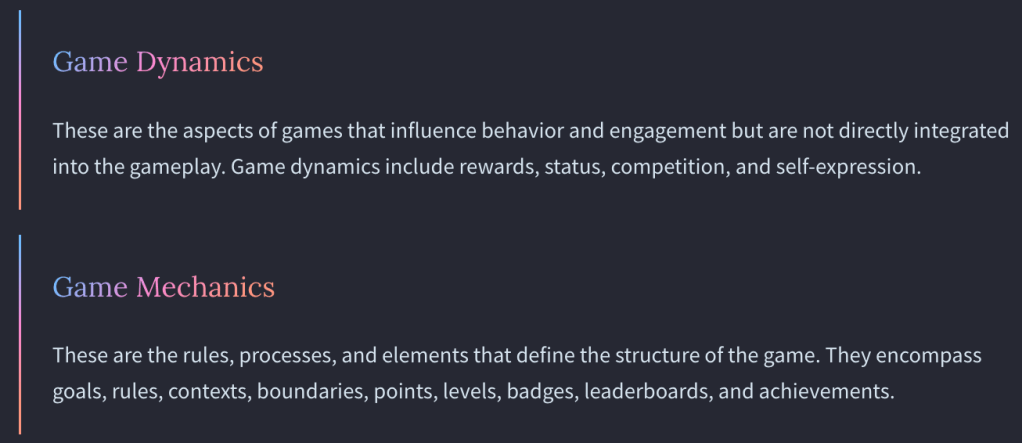
There are three types of game mechanics13:
- Setup mechanics – referring to the context of the experience itself
- rule mechanics – referring to the goals, allowable actions, and constraints
- progression mechanics – referring to the rewards and reinforcements used to influence player behavior
Game dynamics are the behaviors that arise when the mechanics are used18 and embody the direct reaction of the players, making it difficult to predict and leaving room for unintended consequences of the gamification model13.
The Power of Game Mechanics in Education
Many game mechanics have demonstrated their potential for success in educational environments. For example, games enable students to continuously attempt tasks until they acquire the necessary skills. This “mastery learning” approach provides the freedom to fail and experiment without the fear of penalties, ultimately boosting student engagement5.
Game design elements, such as feedback mechanisms, offer students continuous input, alleviating the time-consuming nature of manual grading and providing a more personalized learning experience5.
Common game elements like badges, leaderboards, and points can subtly drive behavior modification. Rules, rewards, and competitiveness can also lead to positive learning outcomes11.
Commonly Used Game Elements
In gamification, various game elements are employed to influence the behavior and attitudes of participants. Let’s explore some of the commonly used elements:
- Avatars: Avatars are characters chosen by players to represent themselves within the game. They promote a sense of autonomy, anonymity, and emotional bonds14.
- Badges: Badges serve as visual representations of achievements14. They reward the mastery of skills on a micro level, providing instant feedback to players. It is worth noting that, while badges can encourage mastery of skill or knowledge if too much (or not enough) emphasis is placed on the attainment of badges, they are likely to create the opposite effect and become de-motivating9.
- Quests/Challenges: Quests set clear goals or challenges for learners, offering a sense of direction and purpose14. Social comparison through quests can lead to healthy competition. It is important to note that competition can produce positive or negative effects on players, depending on whether it is constructive or destructive competition5.
- Feedback: Timely and constructive feedback encourages students to work towards mastery without fear of failure15. However, the type and timing of feedback matter. Feedback types have different effects depending on learner ability, task complexity, timing, and prior knowledge2.
- Goals: Clearly defined goals and rules contribute to the intrinsic value of learning10;16. Specific, measurable, achievable, realistic, and time-bound (SMART) goals enhance completion rates12.
- Leaderboards: Leaderboards rank players based on their point collection, promoting competition and social engagement14;15.
- Points: Points are numerical feedback for specific actions8, aiding extrinsic motivation and providing immediate feedback15.
- Progress Bars: Progress bars offer insights into a player’s progress toward their goals, making the game more engaging and motivating15.
Gamification is not just about adding game elements; it’s about understanding how to use them effectively to enhance the learning experience. By applying elements such as avatars, badges, quests, feedback, goals, leaderboards, points, and progress bars, educators can create engaging and motivating learning environments. When used thoughtfully, gamification can lead to improved student outcomes and a more enjoyable educational journey.
In the coming weeks we will dive into some instructional design models and practices that we can use to implement gamification, ensuring that users gain the best gamified experience to keep them motivated, engaged, and learning!
Conclusion
In conclusion, gamification is more than just a trend; it’s a pedagogical shift that’s redefining how we teach and learn. Embracing gamification in education can unlock the potential for more engaged, motivated, and successful students.
Remember, learning doesn’t have to be dull – with the right gamification strategies, it can be a thrilling adventure!
References
- Cheong, C., Filippou, J., & Cheong, F. (2014). Towards the gamification of learning: Investigating student perceptions of game elements. Journal of Information Systems Education, 25(3).
- Choi, J., Walters, A., & Hoge, P. (2017). Self-reflection and math performance in an online learning environment. Online Learning Journal, 21(4), 79–102. https://doi.org/10.24059/olj.v21i4.1249
- Filatro, A., & Cavalcanti, C. C. (2016). Structural and content gamification design for tutor education. E-Learn: World Conference on E-Learning in Corporate, Government, Healthcare, 2016(1), 1152–1157. https://www.learntechlib.org/p/174055/
- Findlay, J. (2016, August 12). Game-Based Learning vs. Gamification: Do You Know the Difference? Retrieved from https://trainingindustry.com/articles/learning-technologies/game-based-learning-vs-gamification-do-you-know-the-difference/.
- Hanus, M. D., & Fox, J. (2015). Assessing the effects of gamification in the classroom: A longitudinal study on intrinsic motivation, social comparison, satisfaction, effort, and academic performance. Computers and Education, 80, 152–161. https://doi.org/10.1016/j.compedu.2014.08.019
- Huang, B., & Hew, K. F. (2015). Do points, badges and leaderboard increase learning and activity: A quasi-experiment on the effects of gamification. In Proceedings of the 23rd International Conference on Computers in Education (pp. 275-280). Hangzhou, China: Society for Computer in Education. https://www.researchgate.net/publication/286001811
- Kapp, K. (2013, March 25). Two Types of #Gamification ” Karl Kapp. Retrieved from http://karlkapp.com/two-types-of-gamification/.
- Klock, A. C. T., Gasparini, I., Pimenta, M. S., & Hamari, J. (2020). Tailored gamification: A review of literature. International Journal of Human Computer Studies, 144(June). https://doi.org/10.1016/j.ijhcs.2020.102495
- Kopcha, T. J., Ding, L., Neumann, K. L., & Choi, I. (2016). Teaching Technology Integration to K-12 Educators: A ‘Gamified’ Approach. TechTrends, 60(1), 62–69. https://doi.org/10.1007/s11528-015-0018-z
- Landers, R. N. (2014). Developing a theory of gamified learning: Linking serious games and gamification of learning. Simulation & gaming, 45(6), 752-768. https://doi.org/10.1177/1046878114563660
- Landers, R. N., Bauer, K. N., & Callan, R. C. (2017). Gamification of task performance with leaderboards: A goal setting experiment. Computers in Human Behavior, 71, 508–515. https://doi.org/10.1016/j.chb.2015.08.008
- Landers, R. N., & Landers, A. K. (2014). An empirical test of the theory of gamified learning: The effect of leaderboards on time-on-task and academic performance. Simulation & Gaming, 45(6), 769-785.
- Mullins, J. K., & Sabherwal, R. (2018). Beyond enjoyment: a cognitive-emotional perspective of gamification. In Proceedings of the 51st Hawaii International Conference on System Sciences.
- Sailer, M., Hense, J., Mandl, J., & Klevers, M. (2013). Psychological perspectives on motivation through gamification. Interaction Design and Architecture Journal, (19), 28-37.
- Sailer, M., Hense, J. U., Mayr, S. K., & Mandl, H. (2017). How gamification motivates: An experimental study of the effects of specific game design elements on psychological need satisfaction. Computers in Human Behavior, 69, 371–380. https://doi.org/10.1016/j.chb.2016.12.033
- Schulze, S., & van Heerden, M. (2015). Learning environments matter: Identifying influences on the motivation to learn science. South African Journal of Education, 35(2). https://doi.org/10.15700/saje.v35n2a1058
- (Suriano, J. (2017). Office arcade: Gamification, byte-size learning, and other wins on the way to productive human resources. Austin, Texas: Lioncrest Publishing.
- Urh, M., Vukovic, G., & Jereb, E. (2015). The model for introduction of gamification into e-learning in higher education. Procedia-Social and Behavioral Sciences, 197, 388-397. https://doi.org/10.1016/j.sbspro.2015.07.154
 Gamifying your Designs Through Self-Determination
Leave a comment