By Shakiyla Huggins Nov 5th, 2023
The incorporation of gamification strategies has garnered attention for its potential to enrich learning and increase engagement. In a previous blog post, we discussed a Framework for Success that gives seven steps to designing a successful gamfied model from the lens of the Self-Determination Theory. While this framework gave us a high-level overview of how we can design for successful gamification, it did not go in-depth into each of the three psychological needs and how they support gamification on a individual basis.
In this blog post, we will dive deeper into gamification from the lens of the three psychological needs of the Self-Determination Theory. I highly encourage you to take the following strategies and apply them within the corresponding steps of A framework for Success. Just watch how your gamfication design can elevate each of your learners!
The Fundamental Psychological Needs
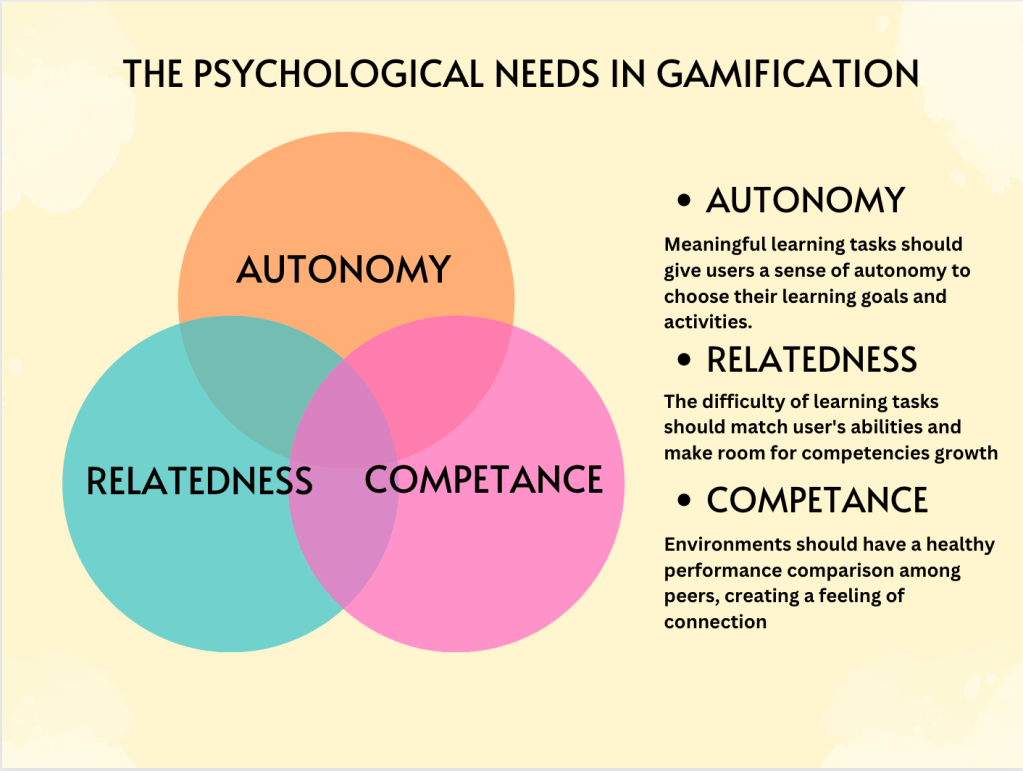
To have meaningful gamification, there are certain ways that the three psychological needs of the self-determination theory should be present1. In general, for any gamified model to be successful, autonomy, competence, and relatedness should be the aim, as these psychological needs ultimately intrinsically sustain and motivate people6. Game properties such as choice, repeatability, and feedback contribute to need satisfaction and enhancement of intrinsic motivation, which are positively related to learning participation and perseverance2.
Autonomy: Fostering Choice and Control
In order for autonomy to be perceived, there must be an experience that allows individuals to make decisions and choose their own actions2. Meaningful learning tasks should give users a sense of autonomy to choose their learning goals and activities. Autonomy-related gamification strategies should include2;5:
- Learning goals with clear descriptions and multiple paths, various interaction tools
- High-level feedback
- Options with consequences
- Customizable learning context
- Voluntary participation in activity
- No negative consequences for non-participation
- Multiple attempts available
- Low stakes failure
- Non-controlling feedback
Game dynamics and components that can support these strategies include2:
- Personalization of profile page
- Control of achievement displays
Further, it is important to note that autonomy should take precedence over competence and relatedness “as autonomous motivation produces greater psychological health and higher quality learning”. Elements should be implemented to support competence and relatedness but not thwart autonomy.
“as autonomous motivation produces greater psychological health and higher quality learning”
(Kam & Umar, 2018, p. 7)
Competence: Balancing Challenge and Success
In order for competence to be perceived, there must be an experience that allows for activites to pose optimal challenges to the learner2. The difficulty of learning tasks should match user’s abilities and make room for competencies growth2. Competence-related gamification strategies should include2;5:
- Small chunks of learning with increasing difficulty
- Options for advancement or retracing
- Frequent decision-making options
- Enjoyable learning tasks
- Optimal challenges
- Short feedback cycles
- Informational feedback
- Competitive elements
Game dynamics and components that can support these strategies include2:
- Points awarded based on performance
- Badges awarded for meeting mastery standards
- Leaderboard display of performance ranking
Using game elements such as points, performance graphs, badges, and leaderboards accounts for the need for competence within the self-determination theory4. Feedback should propel students further in the challenge while sustaining the level of difficulty that produces a sense of mastery or achievement (Kam & Umar, 2018).
Relatedness: Fostering Social Connections
Relatedness is about feeling connected to others and the value that connection brings. Gamified environments should have a healthy performance comparison among peers, creating a feeling of connection2. Relatedness gamification strategies should include2;5:
- Learning communities
- Connections among learner’s of common interests and goals
- Tools for interaction, collaboration, discussion, and assistance
- Visualization of social status.
Game dynamics and components that can support these strategies include2:
- Options to share achievements on profile pages or networking sites
- Leaderboard showing performance in relation to others
Research shows that adding components of social relatedness, such as individual or team competitions, collaborative projects, and opportunities to share achievement, can result in better retention rates and skill acquisition2. Further, important values are more likely to be accepted and internalized when there is an established connection among all parties3.
Conclusion
In conclusion, understanding and implementing the Self-determination Theory within gamified models can significantly impact engagement outcomes. By catering to the psychological needs of autonomy, competence, and relatedness, designers can create an environment that fosters intrinsic motivation and skrocket user or learner engagement.
References
- Huang, B., & Hew, K. F. (2015). Do points, badges and leaderboard increase learning and activity: A quasi-experiment on the effects of gamification. In Proceedings of the 23rd International Conference on Computers in Education (pp. 275-280). Hangzhou, China: Society for Computer in Education. https://www.researchgate.net/publication/286001811
- Kam, A. H., & Umar, I. N. (2018). Fostering authentic learning motivations through gamification: A self-determination theory (SDT) approach. J. Eng. Sci. Technol, 13, 1-9.
- Niemiec, C. P., & Ryan, R. M. (2009). Autonomy, competence, and relatedness in the classroom: Applying self-determination theory to educational practice. Theory and Research in Education, 7(2), 133–144. https://doi.org/10.1177/1477878509104318
- Sailer, M., Hense, J. U., Mayr, S. K., & Mandl, H. (2017). How gamification motivates: An experimental study of the effects of specific game design elements on psychological need satisfaction. Computers in Human Behavior, 69, 371–380. https://doi.org/10.1016/j.chb.2016.12.033
- Shi, L., & Cristea, A. I. (2016). Motivational gamification strategies rooted in self-determination theory for social adaptive e-learning. In Intelligent Tutoring Systems: 13th International Conference, ITS 2016, Zagreb, Croatia, June 7-10, 2016. Proceedings 13 (pp. 294-300). Springer International Publishing.
- Tsay, C. H. H., Kofinas, A., & Luo, J. (2018). Enhancing student learning experience with technology-mediated gamification: An empirical study. Computers and Education, 121, 1–17. https://doi.org/10.1016/j.compedu.2018.01.009
 Gamifying your Designs Through Self-Determination
Leave a comment