By Shakiyla Huggins January 14, 2024

Our favorite buzzword is back: gamification! But this time, we’re not just talking fundamentals and theory; we’re putting it into action!
This gamified experience is backed by various research and theories, mainly the self-determination theory, which we discuss extensively here on our site. However, I want to point you toward another very useful resource, which also aided in structuring this experience. Take a moment to visit the articulate community team’s article on gamification techniques.
With the help of this article and my favorite theory, the self-determination theory, I successfully designed a fully gamified training with features such as personalization, paths/branches, a storyline, avatars, time constraints, loss aversion, challenges, etc. Click here to experience the full training, and read on to see some of the steps taken to build this gamified experience!
Before You Do Anything, Choose Your Topic!
How can you design if you don’t have a topic lol?! You can’t, right?! So let’s talk about the topic of this training.
The topic of this training is mastering email etiquette. Now, since that topic is so broad, let’s add some substance to it and create this interactive training from the perspective of enhancing communication skills via email from the perspective of a manager or employee.
Let the Self-Determination Theory Lead the Way!
I am as much of an advocate for gamification as I am for incorporating the three psychological needs of the self-determination theory. It is one thing for learners/players to have fun while learning. But wouldn’t it be even better if they were not only having fun but also increasing their motivation?
I will only scratch the surface of the self-determination theory here in this post. But, if you need a thorough refresher, please visit my previous post on Designing to Elevate Engagement: The Role of Self-Determination in Gamification. For now, remember that the self-determination theory postulates that for an individual to be self-determined to complete a task, the three psychological needs of autonomy, competence, and relatedness must be present.
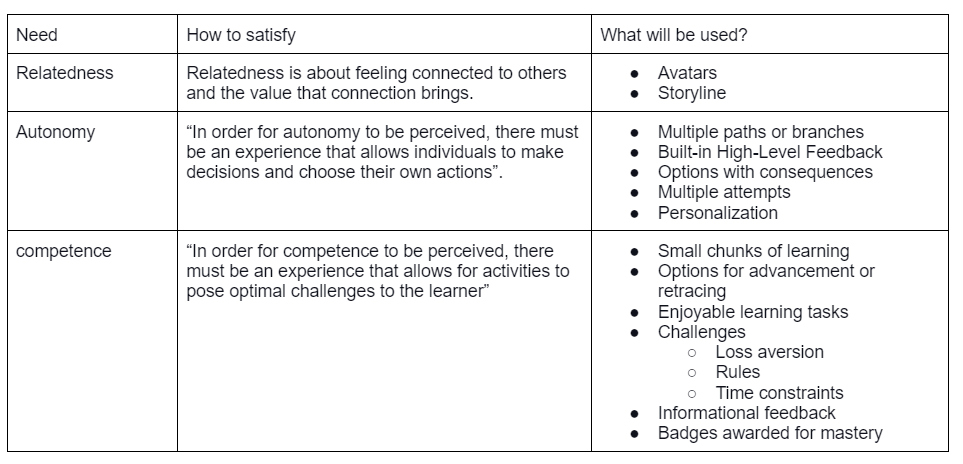
Therefore, let’s begin by determining what game dynamics and mechanics should be present to satisfy each of the three needs of the self-determination theory. In the post above, I break down each of the three needs and what dynamics and mechanics can help satisfy these needs. Let’s use some of those ideals and create a table of dynamics and mechanics that will be included in this email etiquette gamified experience.
Now, Let’s Build our Gamified Training!
Now that there is a solid idea of what should be present to ensure that the learners/players are having fun and feeling motivated, let’s walk through the process of building this gamified experience.
Step 1: Building in Social Relatedness
Let’s start with designing for social relatedness. I like to start with this step because, in my opinion, it’s the easiest of the three. I love writing a good storyline!! So, starting with a storyline and avatars is always my go-to.
I began by personalizing the experience for the learners/players. This will immediately grab the learners’/player’s attention and give them a sense of a personalized path.

Next, let’s add a training specialist named Maxine Summers. Maxine is the main character in the storyline, narrating this experience and helping the learners/players progress successfully through their gamified training experience.

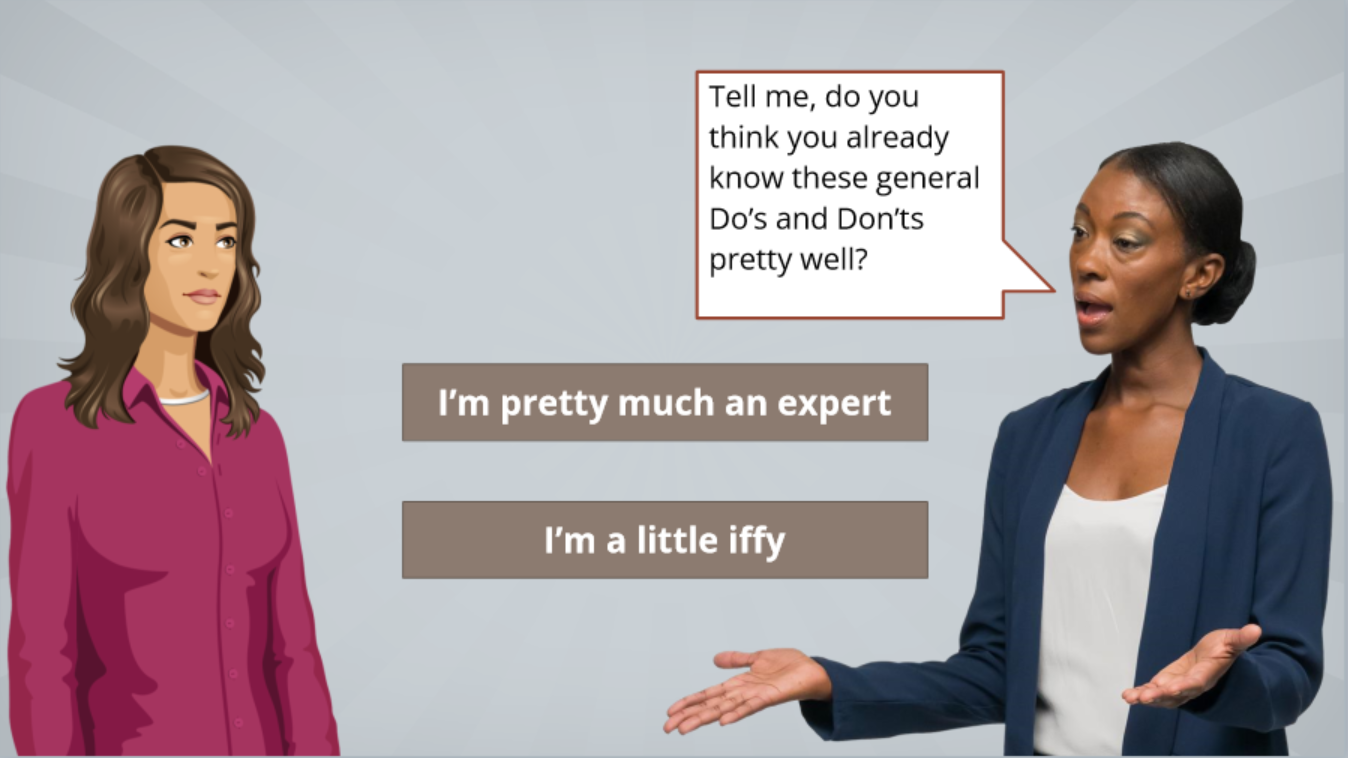
Additionally, since this training is for enhancing communication skills from the manager’s or employee’s perspective, let’s create two avatars, one for each perspective.

The storyline for this experience is simple: Maxine is here to walk the learners/players through a personal experience of effective communication while emailing, depending on whether you are a manager or an employee.
Step 2: Building in Autonomy
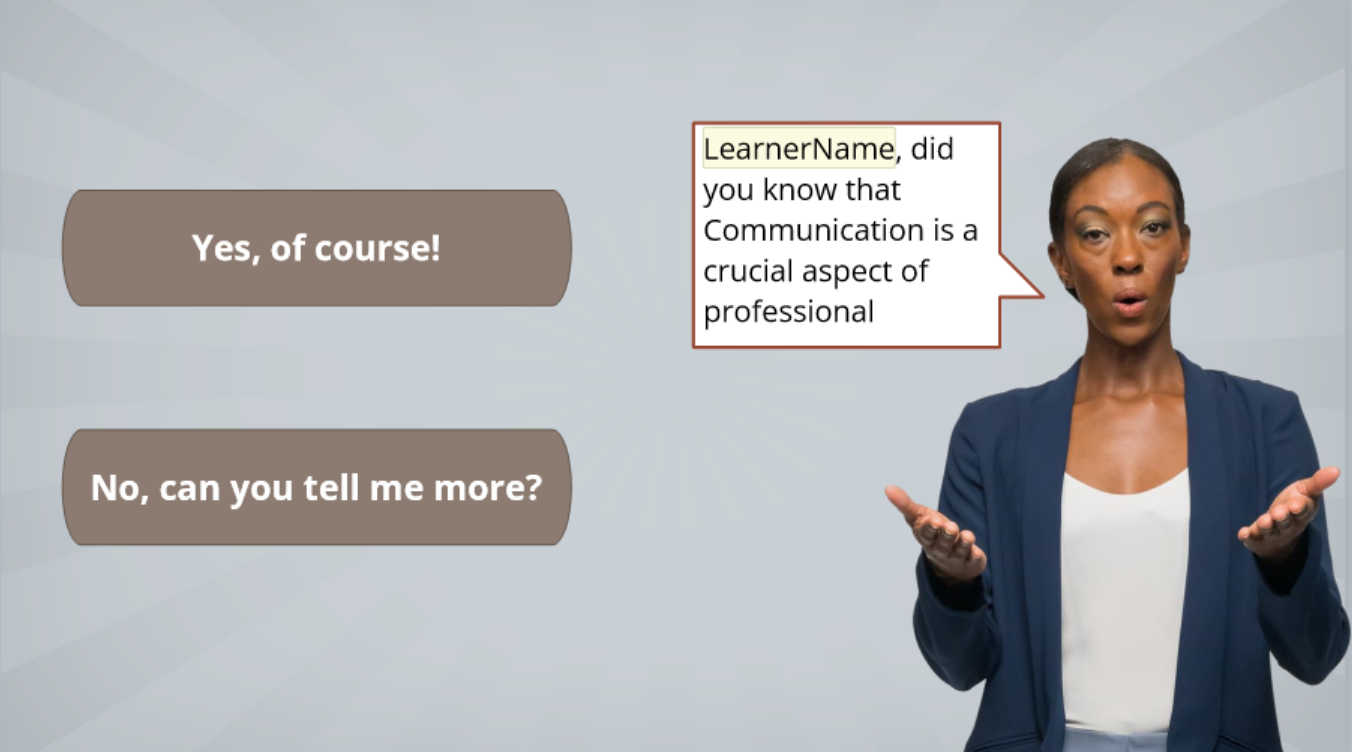
Next, let’s design for autonomy. In the table above, I listed a few dynamics and mechanics for autonomy to be included in this training. In my opinion, the easiest of these to satisfy is creating paths (or branches, as many like to call it). This was a fun design element to think of, and I ended up creating two sections of branches. (Well, technically three branches because choosing an avatar is also a branch)
The first branch simply gauges the player/learner’s knowledge of the need for effective communication.
The other branch gives learners/players the opportunity to express their skill level. This branch was intentional as it is the segway into the challenge!
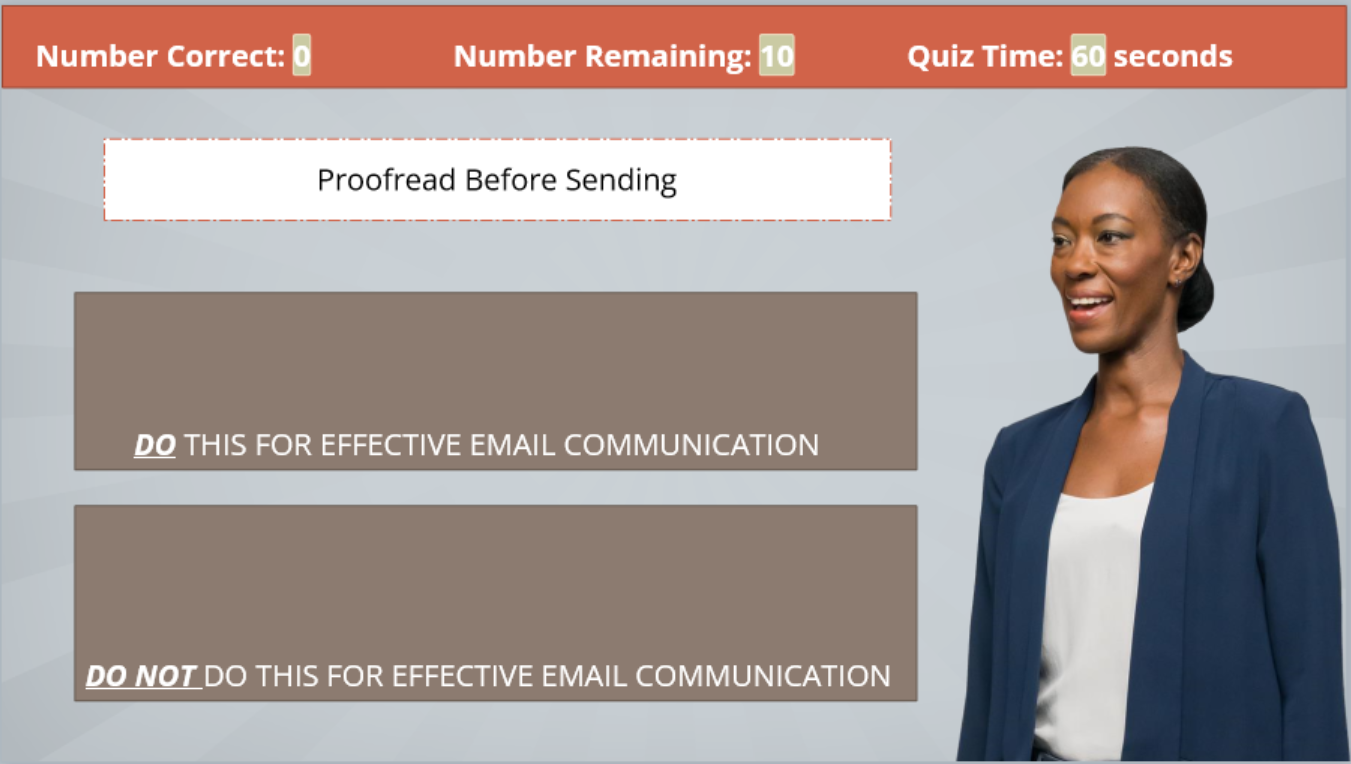
Next, I also created a drag-and-drop activity to satisfy built-in feedback and options with consequences. Now, this activity is not your usual drag and drop. In the next section, I will talk a little more about this!
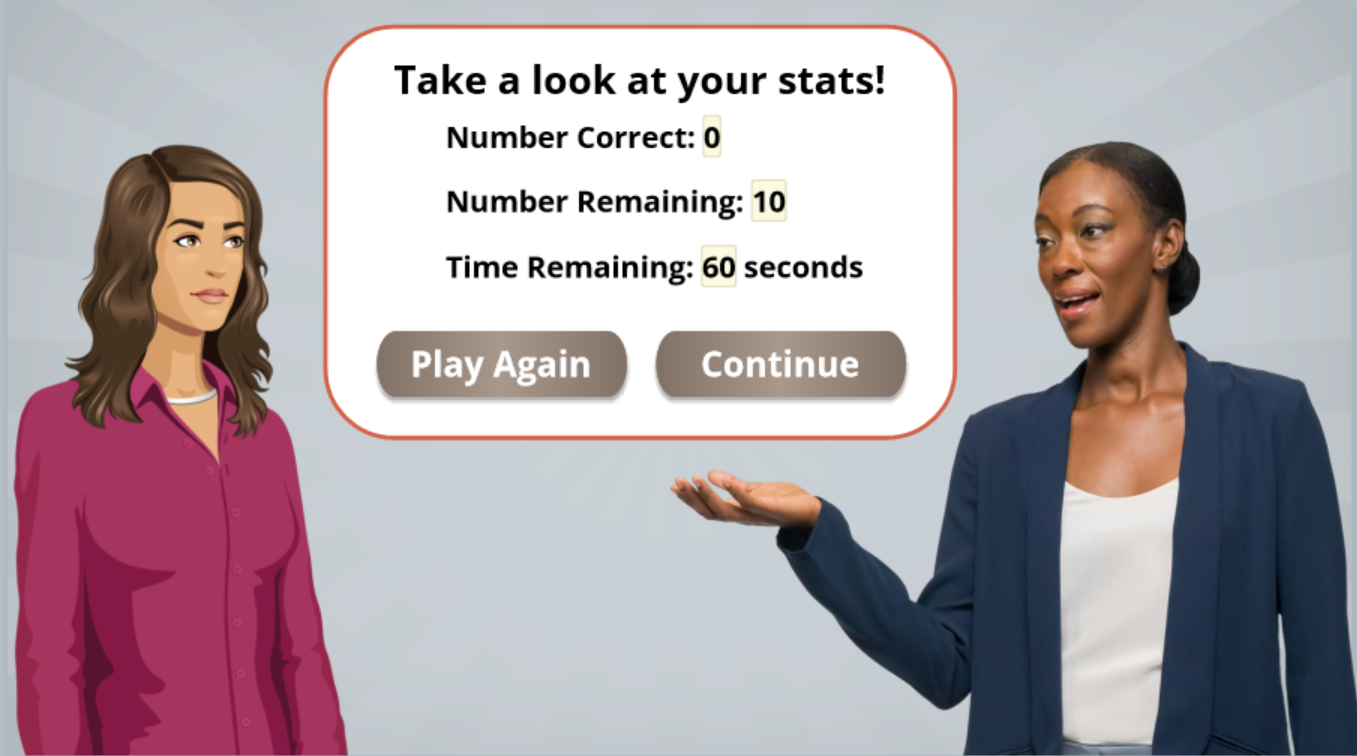
Finally, let’s satisfy multiple attempts by allowing the learners/players to try again as often as they would like.
Step 3: Building in Competence
Our table above has several features that will help foster competence. I won’t go into great detail about all of them, but I would like to focus on three. The last three, to be exact, challenges, informational feedback, and badges to award mastery.
Let’s start with challenges. Do you remember that drag-and-drop I mentioned earlier? Man-oh-man, did I have quite the experience building this!
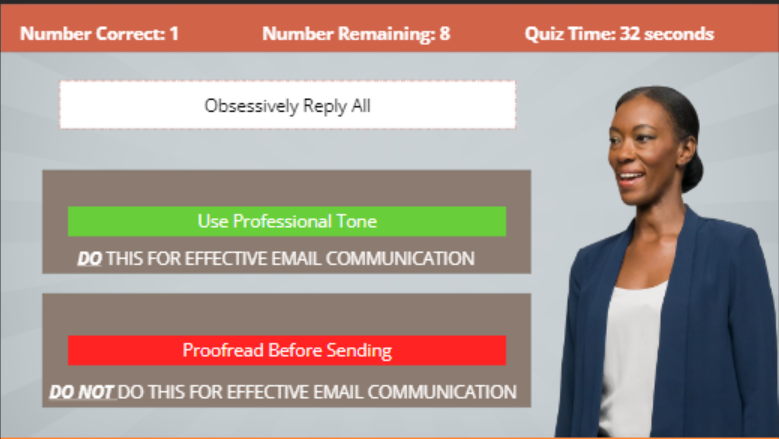
Learners/players experienced this drag-and-drop based on the skill level they disclosed in the path discussed earlier. If the learners/players expressed that they were a little iffy, they could learn the information first and then use this drag-and-drop as a timed knowledge check. If they said they were experts, they were immediately given this drag and drop as a timed challenge.
So what exactly made this same activity a challenge vs a knowledge check? Loss aversion! During the challenge version of this drag and drop, learners/players were penalized by 5 seconds for every incorrect answer they submitted. Instead of having the full 60 seconds that are originally allotted, learners/players can reduce their time allotment, endangering their chances of finishing! This loss aversion is not applied to the knowledge check version, as the user indicated they are not as knowledgeable in this content, and it would be detrimental to their need for competence. I truly hope you enjoy this feature as much as I did while building it!
Also, learners/players are provided with the opportunity to engage in a review of this content.

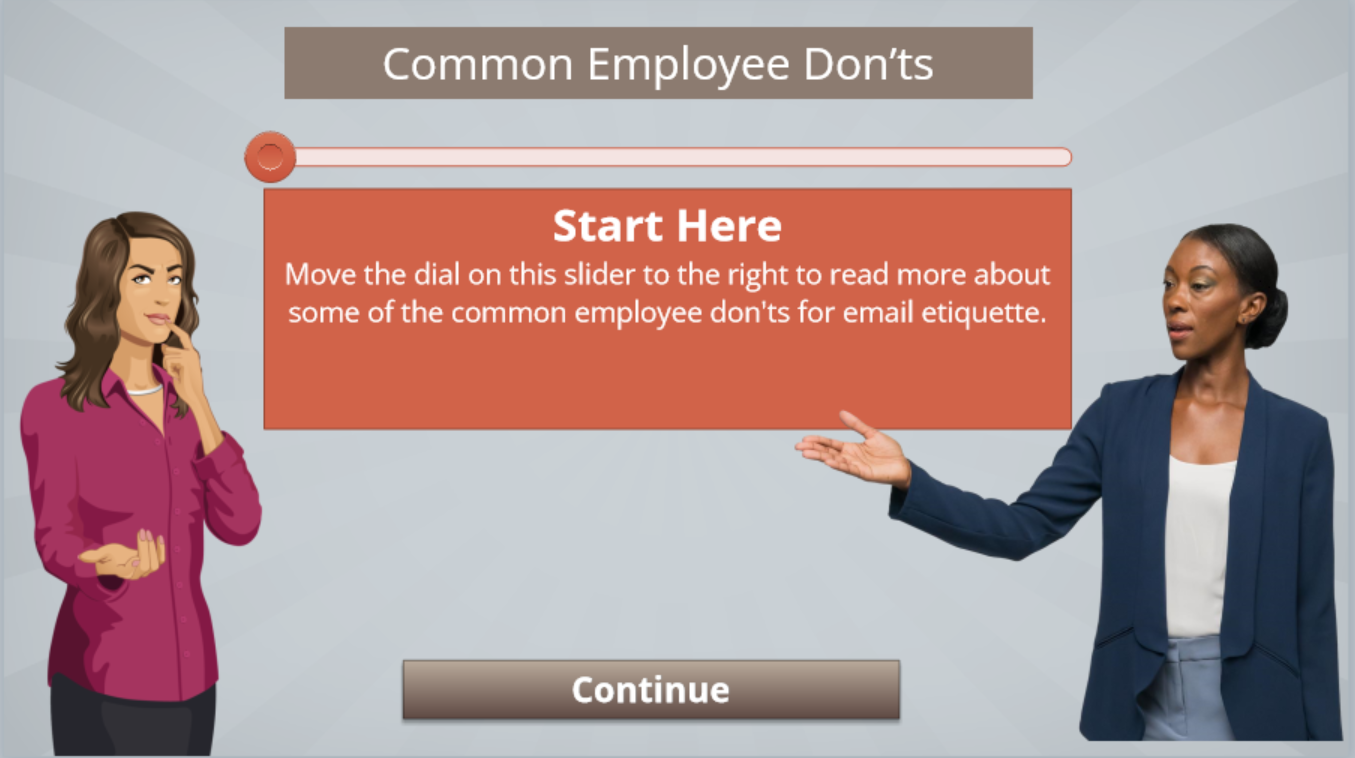
Content pages are built into their experience based on their self-proclaimed level of knowledge. For self-proclaimed experts, learners/players engaged with the content after their challenge as a review. On the other hand, those users who self-proclaimed not to be as knowledgeable received the content beforehand as a small chunk of learning.
Finally, let’s discuss informational feedback and badges to award mastery.
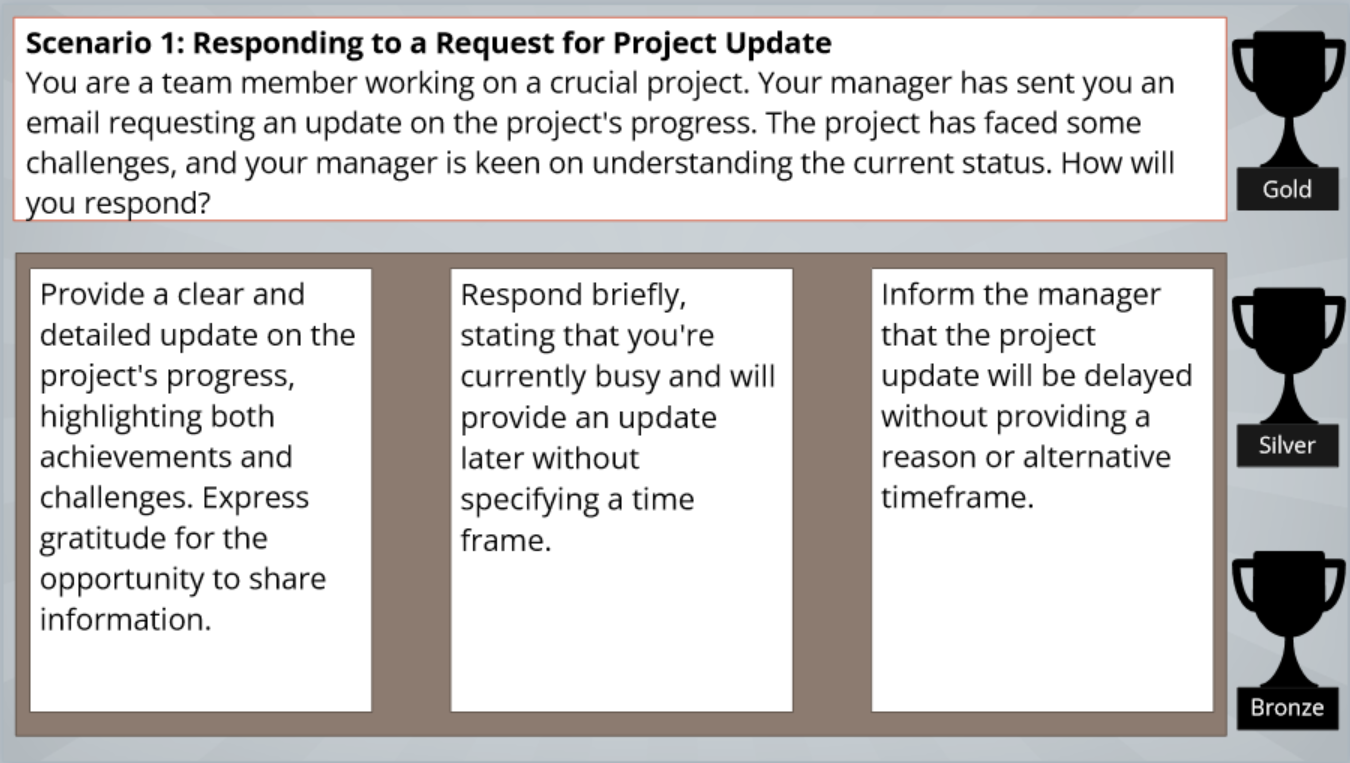
At the end of this gamified training, learners/players are given three real-world scenarios to navigate. Three choices accompany these scenarios. One choice will have a positive outcome, while the others will garner a negative outcome. Learners/players are given this feedback in two manners.
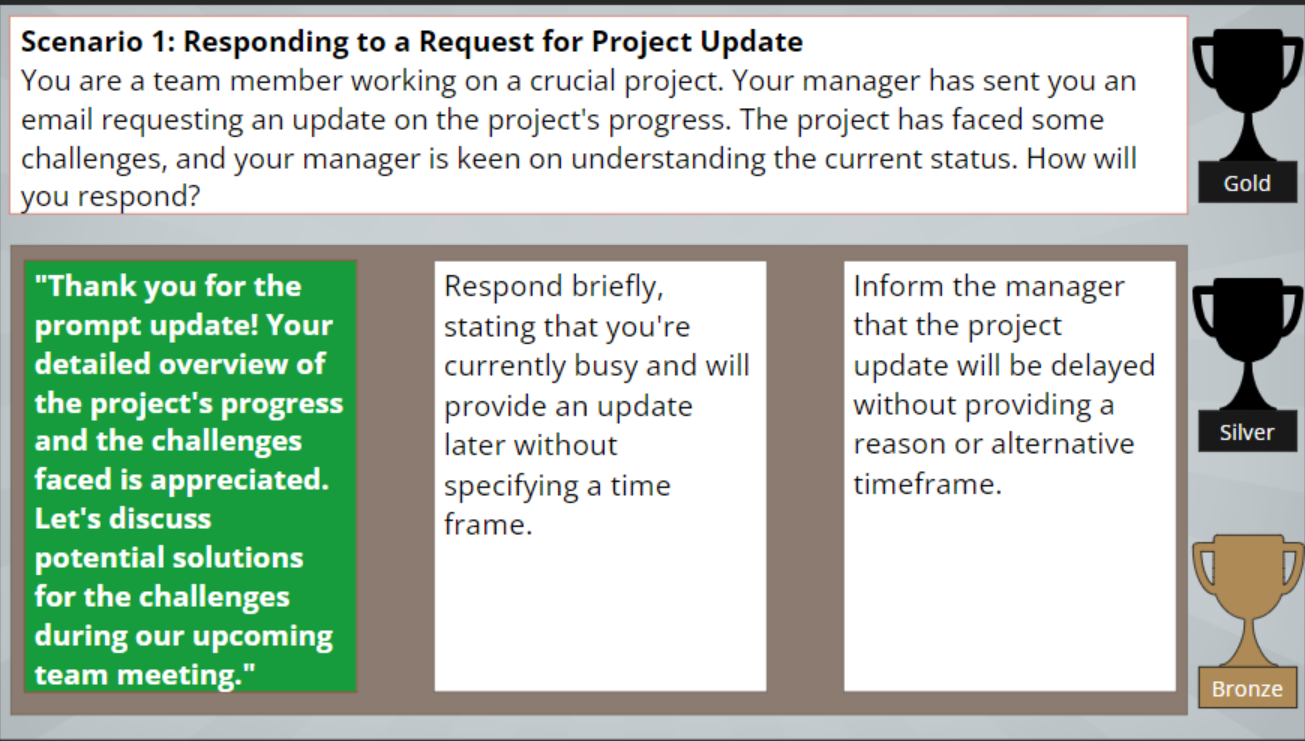
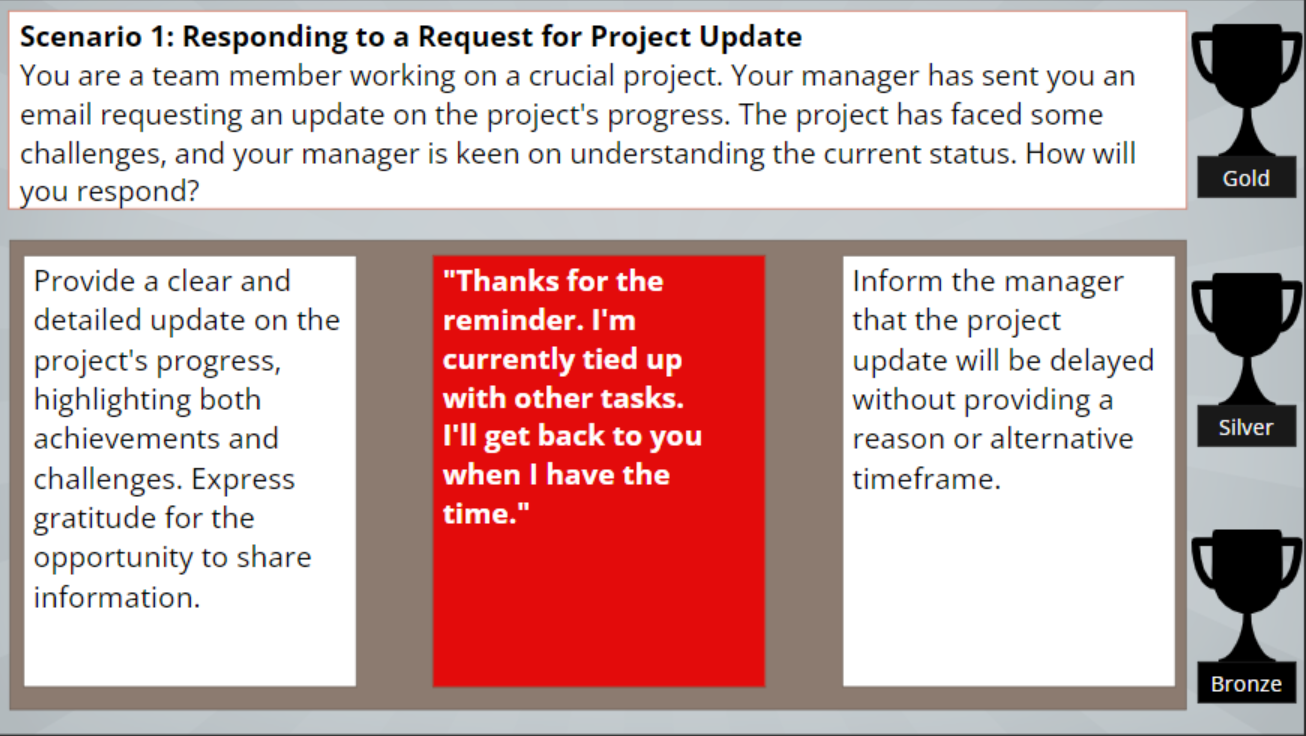
First, when they click on their desired response, they are immediately given a response email highlighted as green or red. The green indicates a positive outcome, and the red indicates a negative outcome. Learners/players are also awarded a trophy for each correct response. These trophies are only rewarded for correct answers and will change to their appropriate color when the learners/players click the correct response. This gives the learner not only an auditory form of feedback but a visual cue as well.
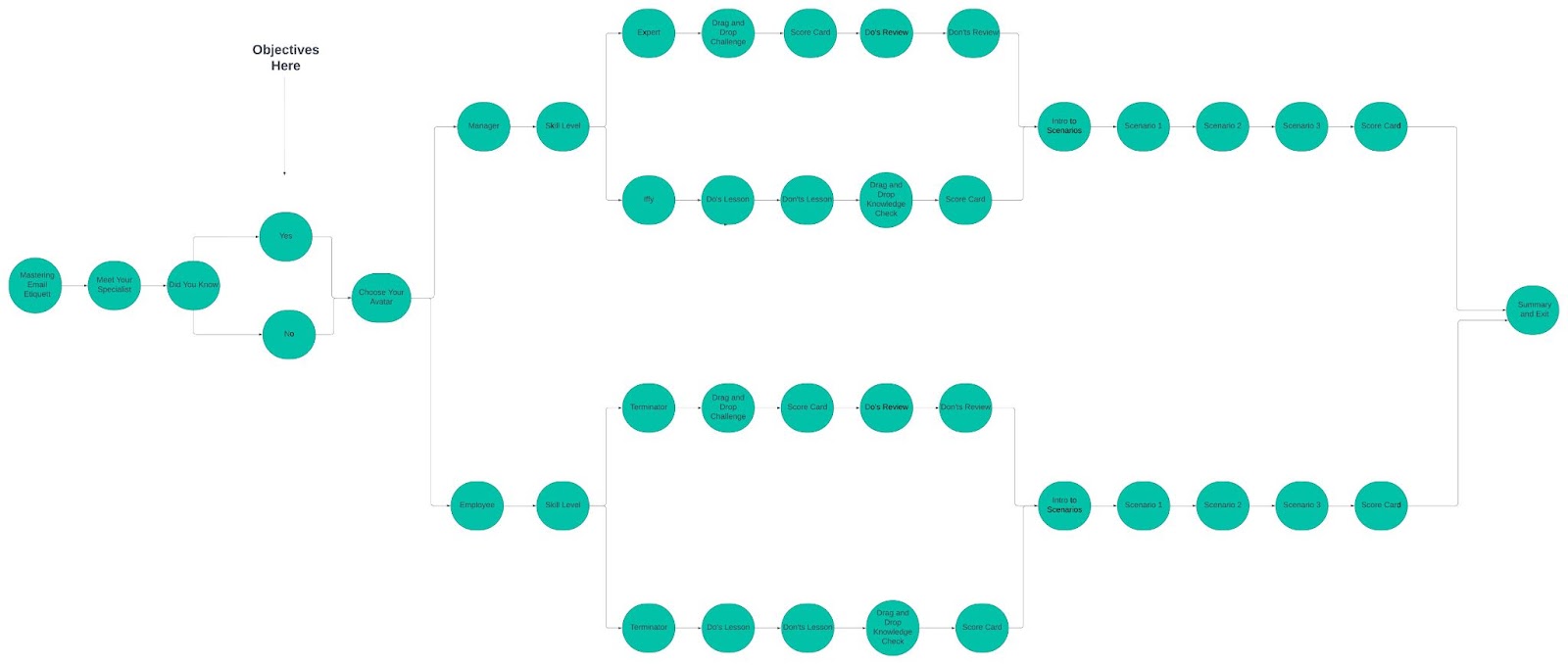
Before we conclude, remember that this gamified experience can be interacted with from two perspectives: the employee or the manager. Therefore, the drag-and-drop and the real-world questions have two different sets of information and scenarios. So, this gamified experience has two different built-in paths. Take a look at the flow chart below.
Conclusion: Elevate Your Learning Experience
As you embark on your gamification journey, consider the principles explored here. Whether you’re an educator, instructional designer, or simply someone passionate about enhancing learning experiences, gamification can elevate engagement and motivation.
Ready to embark on your gamification journey? Click here to experience the full training and let the principles of gamification elevate your learning initiatives. Gamify with purpose, and watch your audience thrive in the world of engaging and impactful education!
 Gamifying your Designs Through Self-Determination
Leave a comment