By Shakiyla Huggins March 6, 2024

Welcome back to your favorite space for instructional design and gamification. Today we are adding to our list of frameworks that drive the instructional design of effective gamification, rooted in the Self-Determination Theory.
If you haven’t already, take a moment to read the first framework in this series, Di Tomasso’s A Framework for Success . It is a very powerful and well structured framework that I am confident you will love. In the meantime, let’s dive right into our next framework! Make sure you stick around to the end to see a complete example!
Introduction
In today’s digital age, gamification has emerged as a powerful tool to drive engagement, motivation, and user participation across various domains, from education to marketing and beyond. But what truly makes a gamified system effective? How can designers ensure that their gamification efforts not only captivate users but also fulfill their objectives?
Enter Francisco-Aparicio et al. (2013) and their groundbreaking framework that provides a roadmap for designing and evaluating gamified systems. This five-step framework allows for determining what type of game mechanics should be incorporated to meet the three psychological needs of motivation, while also assessing the effectiveness of the process of gamification based on fun, the properties that characterize playability, and the degree of improvement in obtaining satisfactory results. Let’s delve into each step to uncover the secrets of effective gamification.
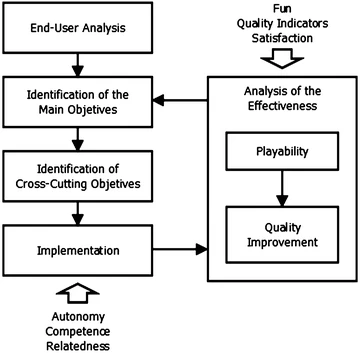
1. End-User Analysis: Understanding the target audience is paramount in designing a successful gamified experience. Designers delve deep into users’ needs, interests, motivations, and preferences to tailor the gamified model accordingly. By empathizing with the end-users, designers can create experiences that resonate and drive engagement.
Before diving into the world of game mechanics and objectives, it’s crucial to understand the players themselves. Who are they? What motivates them? What are their pain points and preferences? Conducting thorough user research, including surveys, interviews, and user testing, can provide invaluable insights into the target audience’s psyche.
For example, let’s consider a fitness app aiming to gamify workouts. Through user analysis, designers may discover that their target audience consists mainly of busy professionals looking to stay fit amidst hectic schedules. Armed with this knowledge, they can tailor the gamified experience to include short, high-intensity workouts and challenges that align with users’ time constraints and goals.
2. Identification of Main Objectives: Clarifying the main objectives of gamification sets the foundation for the entire process. Designers identify tasks that need gamification and align them with overarching goals. While some tasks may lack inherent motivation, gamification can enhance their efficiency, contributing to overall objectives.
Once the players’ personas are clear, it’s time to define the main objectives of gamification. These objectives serve as the guiding principles that drive the entire gamification process. Whether it’s increasing user engagement, fostering learning, or driving behavior change, aligning objectives with business or educational goals is essential.
Let’s take the example of a language learning platform seeking to gamify the learning experience. Their main objective might be to increase user retention and proficiency levels. To achieve this, they could gamify vocabulary acquisition by incorporating game mechanics like quizzes, leaderboards, and rewards, all aimed at making language learning more enjoyable and effective.
3. Identification of Cross-Cutting Objectives: Identifying transversal objectives that interest players is crucial for fostering intrinsic motivation. These objectives serve as the basis for selecting appropriate game mechanics that not only enhance engagement but also promote personal growth and satisfaction.
Cross-cutting objectives bridge the gap between individual tasks and overarching goals, fostering a sense of purpose and intrinsic motivation among players. These objectives resonate with users on a deeper level, driving engagement and fostering a sense of accomplishment.
Continuing with our language learning platform example, a cross-cutting objective could be fostering a sense of community among learners. By incorporating social features such as forums, chat rooms, or collaborative challenges, the platform encourages users to connect with fellow learners, share experiences, and support each other’s language journey.
4. Implementation: This step is where the magic of gamification happens. With objectives in place, it’s time to bring the gamified experience to life. Designers select game mechanics that correspond to the identified objectives and support users’ psychological needs for autonomy, competence, and relatedness. Each mechanic is carefully chosen to create a cohesive and immersive experience.
This step involves selecting and implementing game mechanics that not only align with the identified objectives but also cater to users’ psychological needs for autonomy, competence, and relatedness.
In our fitness app example, implementation might involve integrating features like customizable workout plans, progress tracking, and social sharing options. By giving users autonomy over their fitness journey, providing opportunities to track and celebrate progress, and fostering a sense of community, the app creates a compelling and motivating experience.
5. Analysis of Effectiveness: The final step involves evaluating the effectiveness of the gamified process through two lenses: fun generation and playability assessment. Playability is defined as the set of properties that describe the player’s experience while engaging with a gamified system.
The analysis of fun or playability cannot be done in isolation; it requires user testing and the completion of questionnaires to gather feedback directly from the players. Two main metrics are recommended for this analysis:
- Selection of Quality Indicators: This metric focuses on evaluating the degree of satisfaction achieved and the overall quality reached by the players at the end of the gamification process. It involves defining specific quality indicators that are linked to the objectives and context of the gamification. These indicators are used to assess how well the gamified system meets its intended goals and whether it provides a satisfying experience for the players.
- Satisfaction and Quality of Service: This metric is aimed at evaluating the service provided by the gamification model. It assesses whether the gamified system effectively reaches the goals and objectives set during the initial phases of development. A quality of service model is recommended to establish quality parameters that align with the identified objectives. By comparing these parameters over different iterations or before and after the development of the gamified model, it becomes possible to determine if the gamified system has successfully fulfilled its purpose.
By collecting and analyzing data on metrics such as user engagement, satisfaction, and task completion rates, designers can gain valuable insights into what’s working and what needs improvement.
For our language learning platform, effectiveness analysis might involve tracking user engagement metrics such as daily active users, time spent on platform, and proficiency levels over time. By iterating based on user feedback and performance data, the platform can continuously refine and enhance the gamified experience to better meet users’ needs and goals.
Measuring Success: Metrics like selection of quality indicators and satisfaction, coupled with assessing the quality of service, offer tangible measures of gamification effectiveness. By comparing these metrics across iterations or before and after implementation, designers can ascertain whether the gamified model has achieved its intended purpose.
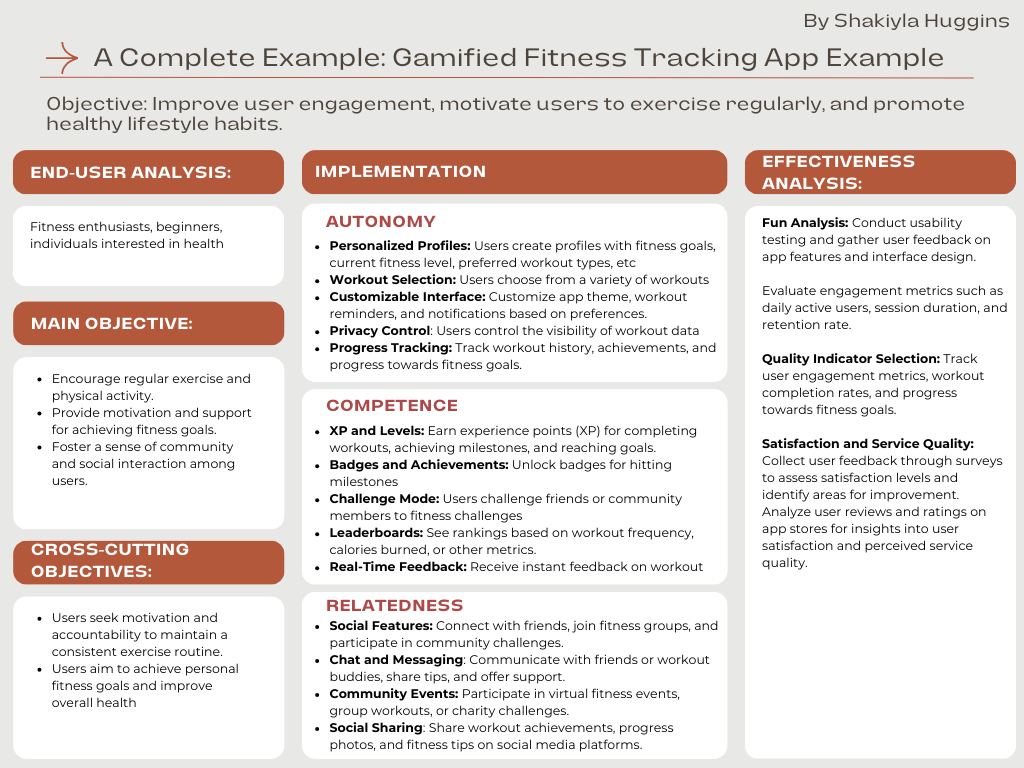
A Complete Example: Gamified Fitness Tracking App Example
Conclusion
In conclusion, Francisco-Aparicio et al.’s framework provides a structured approach to designing and evaluating gamified systems. By focusing on understanding users, defining objectives, selecting appropriate mechanics, and analyzing effectiveness, designers can create engaging and effective gamified experiences that drive meaningful outcomes. As we continue to harness the power of gamification, leveraging frameworks like these will be key to unlocking its full potential in various domains.
Francisco-Aparicio, A., Gutiérrez-Vela, F. L., Isla-Montes, J. L., & Sanchez, J. L. G. (2013). Gamification: analysis and application. In New trends in interaction, virtual reality and modeling (pp. 113-126). Springer, London.
 Gamifying your Designs Through Self-Determination
Leave a comment