Dr. Shakiyla Huggins, EdD November 9, 2025
When I first began integrating gamification into course design, the initial excitement among learners was undeniable. But I quickly noticed a common challenge: engagement often faded after the first few weeks. This “novelty drop-off” is one of the most cited limitations in gamification research.
That’s where the Sustainable Gamification Impact (SGI) Framework comes in. Developed by Al Marshedi et al. (2015), the framework addresses one of the most pressing issues in gamified learning—how to maintain motivation once the excitement of points and badges wears off. It brings together three major theoretical foundations:
- Flow Theory (Csikszentmihalyi, 1990), which describes deep focus and immersion in a balanced challenge.
- Drive Motivation Theory (Pink, 2009), which emphasizes autonomy, mastery, purpose, and relatedness.
- Self-Determination Theory (SDT) (Ryan & Deci, 2000), which explains how autonomy, competence, and connection foster intrinsic motivation.
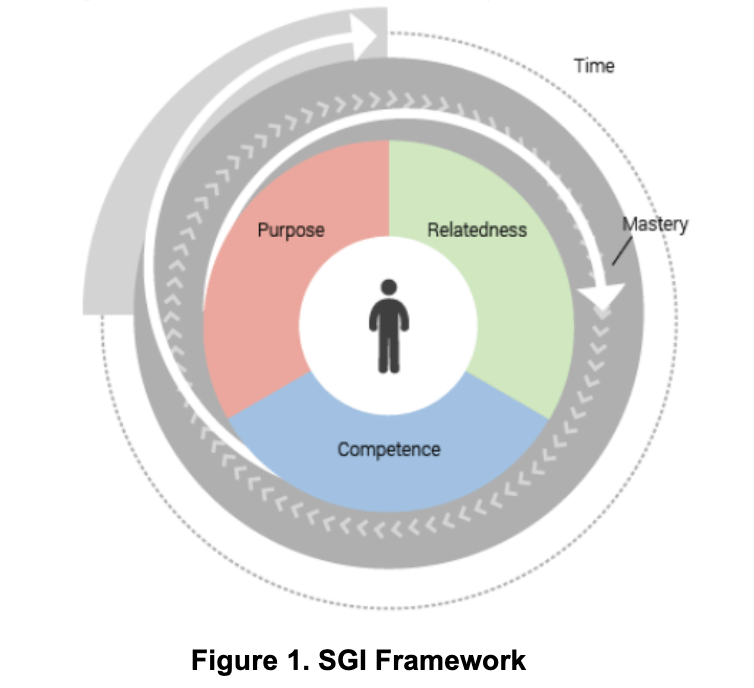
Together, these perspectives form a roadmap for designing gamified experiences that are not only enjoyable but sustainably impactful.
Inside the SGI Framework
The SGI Framework identifies five interrelated elements—flow, relatedness, purpose, autonomy, and mastery—that support meaningful and lasting engagement. Think of these as the “pillars” of sustainable gamification. Each can be intentionally designed into learning experiences to promote intrinsic motivation and learner growth.
1. Flow: Immersion Through Balanced Challenge
Flow occurs when learners are fully absorbed in an activity, losing track of time because the challenge perfectly matches their skills (Csikszentmihalyi, 1990). SGI highlights flow as essential for maintaining engagement because it creates a sense of control, curiosity, and self-driven focus.
Design Reflection:
To create flow, align tasks with learners’ current ability levels and ensure consistent, meaningful feedback. In Storyline, for instance, this might look like adaptive branching scenarios that scale in complexity as learners progress. When challenges evolve in sync with skill development, motivation becomes self-sustaining.
2. Relatedness: Connection and Belonging
Relatedness is about fostering social and emotional connection within the learning environment. According to Al Marshedi et al. (2015), meaningful interactions—whether through collaborative missions or shared narratives—help learners feel part of something larger than themselves.
Design Reflection:
Build relatedness through peer leaderboards, discussion-based debriefs, or shared progress dashboards. Even simple narrative framing—like positioning learners as part of a “team of explorers” working toward a shared goal—can heighten belonging and long-term engagement.
3. Purpose: Meaningful Goals and Feedback
Purpose gives learners a reason to care. Within SGI, purpose is tied to autotelic experiences—activities that are fulfilling in and of themselves, not just for an external reward. Meaningful goals and clear feedback loops keep learners focused and emotionally invested.
Design Reflection:
Clarify the “why” behind each activity. Replace arbitrary points with purpose-driven rewards—such as unlocking new storylines or contributing to a shared knowledge base. Align feedback with learner progress and values rather than with competition alone.
4. Autonomy: Empowering Learner Choice
Autonomy, a cornerstone of Self-Determination Theory, is the feeling of ownership and control over one’s learning journey. SGI positions autonomy as a vital factor for intrinsic motivation, allowing learners to choose how and when to engage.
Design Reflection:
Give learners agency. Offer optional quests, alternative pathways, or the ability to select the order of challenges. For example, in a gamified biology course, students might choose which “cell structure mission” to complete first, fostering both freedom and investment in their learning experience.
5. Mastery: Growth, Feedback, and Progress
Mastery represents the ongoing journey of improvement—“getting better at something that matters” (Pink, 2009). In SGI, mastery builds over time as learners balance skills, challenges, and reflection. It’s what transforms gamified experiences into long-term learning cycles rather than one-time events.
Design Reflection:
Incorporate progress visibility. Dashboards, progress bars, or achievement maps can help learners see their growth. Scaffold tasks so that success at one level builds confidence for the next. Celebrate improvement, not perfection—learners should feel empowered to iterate, not pressured to perform.
Key Takeaways
The Sustainable Gamification Impact Framework reminds us that gamification is most effective when it moves beyond surface-level mechanics and taps into the psychology of lasting motivation. Sustainable engagement happens when learners feel challenged yet capable, autonomous yet connected, and always clear on why their effort matters.
As an instructional designer, I see SGI as more than a theory—it’s a practical lens for designing experiences that build skill, confidence, and community over time. Whether applied in corporate learning, higher education, or K-12 classrooms, it offers a research-based foundation for creating gamified experiences that truly endure.
Learn More
To explore the original research, see:
Al Marshedi, A., Wills, G. B., Wanick, V., & Ranchhod, A. (2015). SGI: A Framework for Increasing the Sustainability of Gamification Impact. International Journal for Infonomics, 8(2), 1044–1051.*
Available at ResearchGate.
For more articles on gamification design and instructional innovation, visit GamifyEduPro.blog.
 Gamifying your Designs Through Self-Determination
Leave a comment