What AI Taught Me About My Own Career
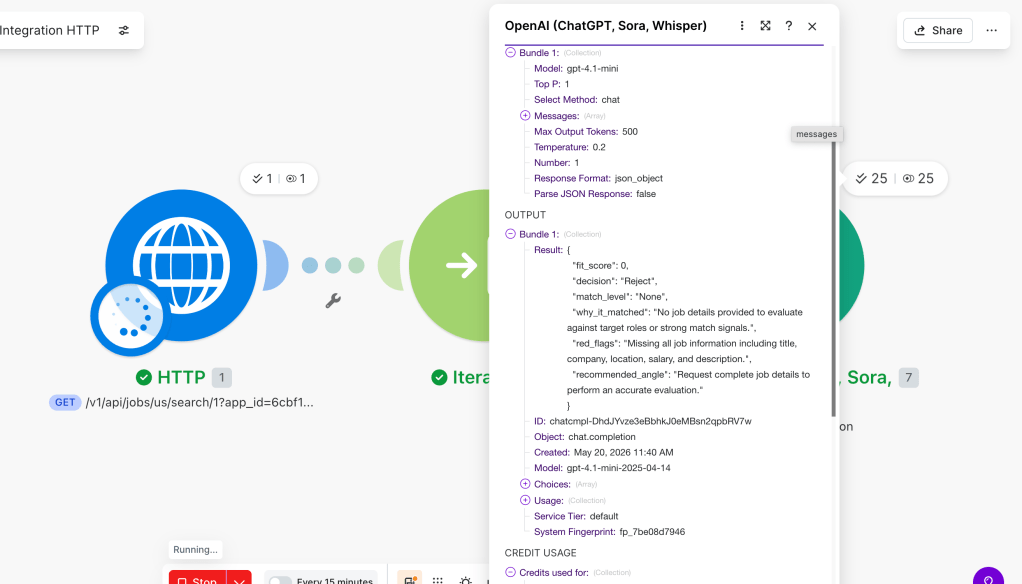
Over the past few days, I’ve been working on building something I’ve never built before: an AI-powered career agent.
The original idea was simple.
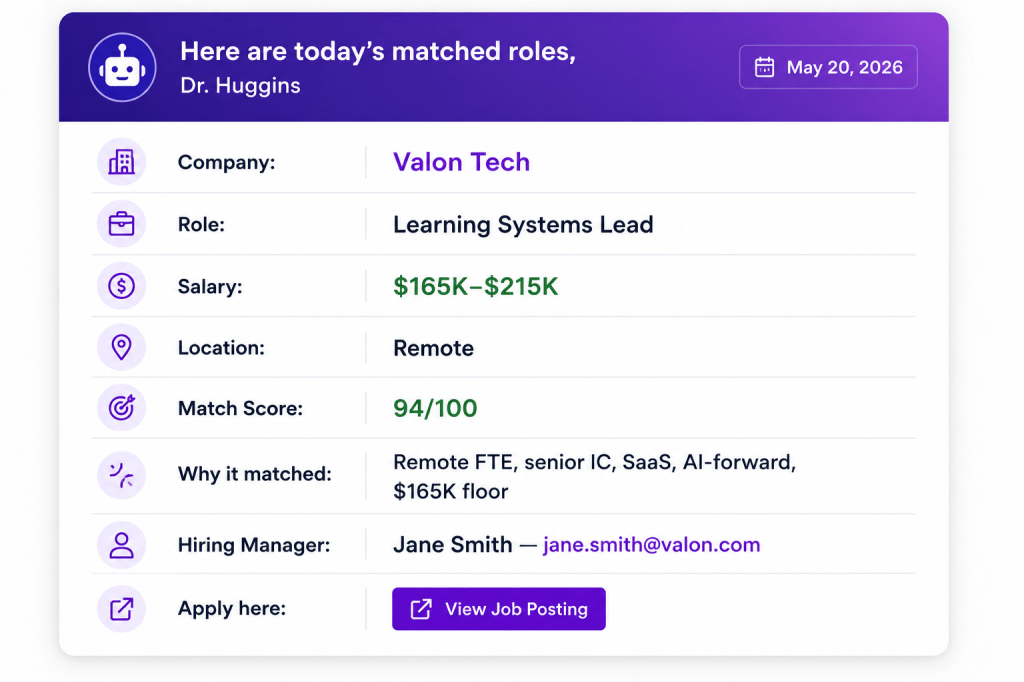
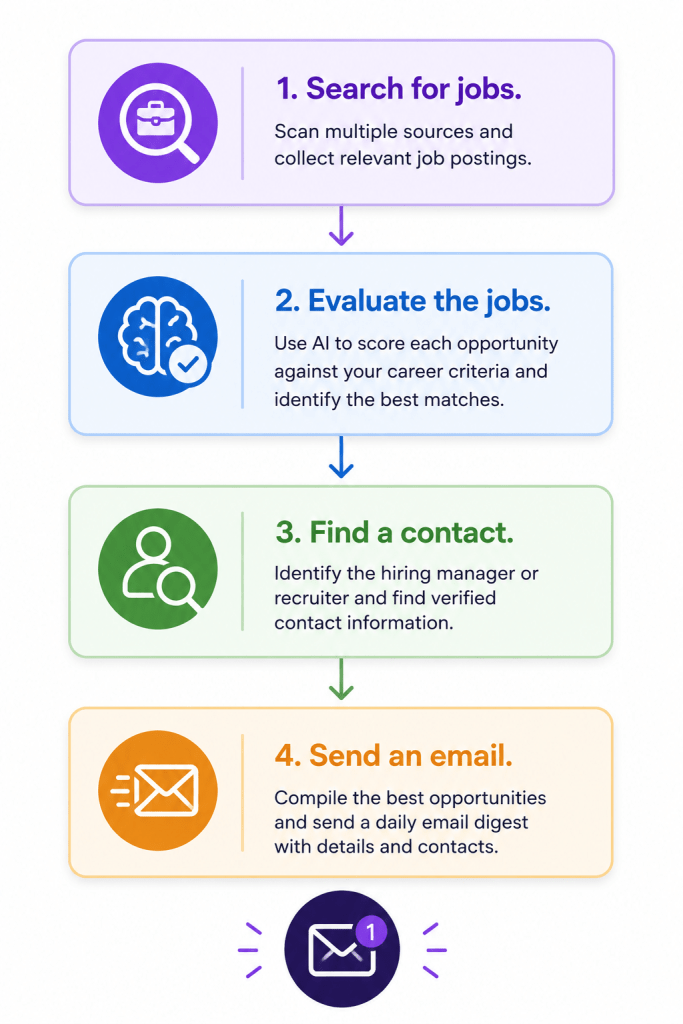
I wanted a system that would wake up every morning, search for jobs that aligned with my career trajectory, identify the hiring manager or recruiter, and send me a single email summarizing the best opportunities.
No manual searching. No endless scrolling on LinkedIn. No checking company websites every day.
Just one email. Something like this:
At first, that sounded incredibly straightforward. In reality, it quickly turned into a lesson in systems thinking.
Part 1: Build the pipeline
The initial architecture seemed simple enough.
I already had an Adzuna API account and a Make account, so those became my starting point.
The workflow looked like this:
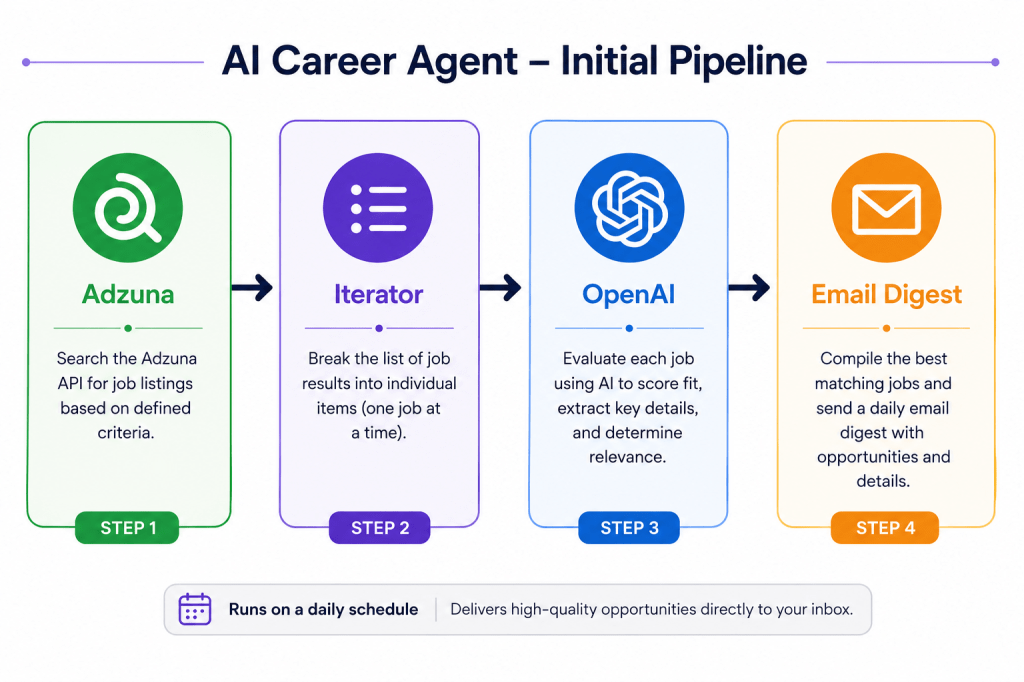
The Iterator would allow Make to evaluate jobs one at a time, and OpenAI would become the “brain” of the operation.
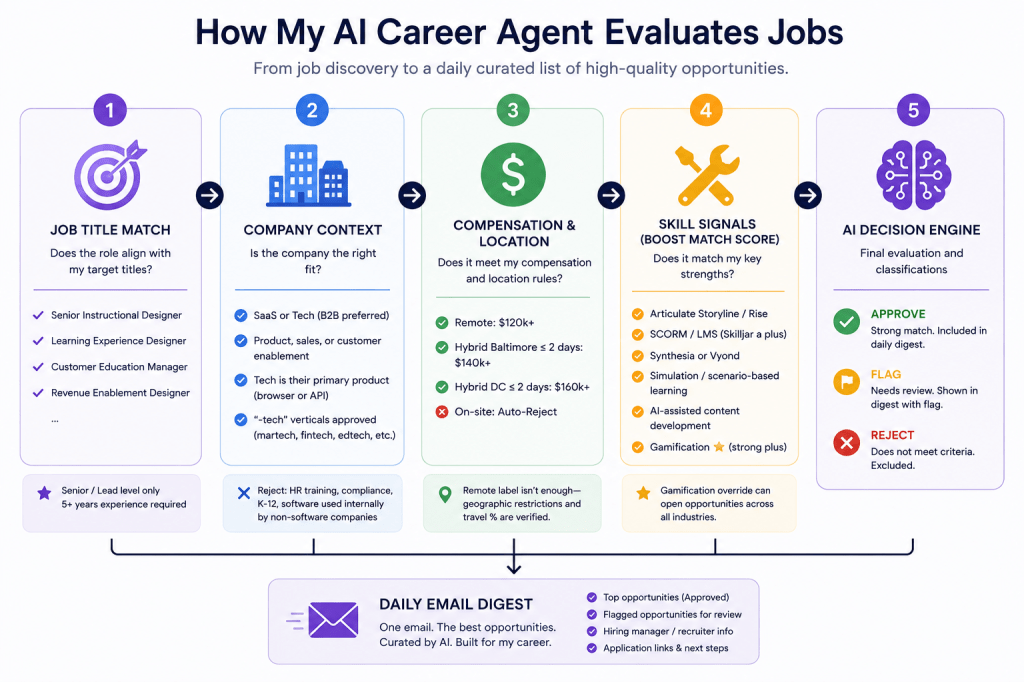
I had also previously built a detailed Job Match Profile that outlined exactly what I wanted.
Titles such as:
- Senior Instructional Designer
- Learning Experience Designer
- Technical Enablement Designer
- Customer Education Manager
- Revenue Enablement Designer
I also established hard rules.
Reject:
- On-site roles
- Generic HR training
- Compliance training
- K-12 positions
- Non-SaaS organizations
- Remote jobs under $120k
At this point, I thought I had everything figured out.
I was wrong.
Part 2: The AI worked perfectly…
…but the results were terrible.
After running the first few searches, I started seeing jobs like:
- Physical Therapist
- Machine Operator
- Relationship Banker
- Kindergarten Teacher
- Speech Therapist
At first, I thought something was broken. But after digging into it, I realized something important. The AI wasn’t broken. It was doing exactly what I asked it to do.
Every single one of those roles was correctly rejected.
The problem wasn’t the AI. The problem was the source. I had assumed that finding jobs was the easy part and evaluating them was the hard part.
It turns out it’s the opposite. Finding good opportunities is the hard part. Evaluating them is relatively easy.
Part 3: Adzuna wasn’t bad. It just wasn’t built for me.
Even when I searched for “Instructional Designer,” Adzuna still surfaced:
- K-12 teachers
- Healthcare trainers
- Banking professionals
- Airline training roles
- Compliance trainers
That was the first major realization. I don’t need better AI. I need better sources.
At one point, I thought: Maybe I should just monitor 50 companies. That would make things much cleaner.
Companies like:
- Postman
- Datadog
- OpenAI
- Anthropic
- Figma
- HubSpot
That idea sounded fantastic…
…until I remembered Metric5.
Earlier this year, I interviewed for an AI Learning Specialist role at Metric5. That role was almost perfect for my trajectory. But I never would have found it if I only monitored SaaS companies.
That realization changed everything.
I couldn’t build a system around predictability because my own career trajectory isn’t entirely predictable anymore.
Part 4: I realized my market positioning has changed
I used to think of myself as an instructional designer. But now, I’m not sure that’s true anymore.
I’m somewhere between:
- Technical Enablement
- Customer Education
- Product Education
- AI Learning
- Learning Science
- Gamification
- Behavior Change
- Strategic Enablement
That’s an awkward place to occupy. But it’s also a strength. Because some of my best future opportunities won’t have obvious titles. They may not even have “Instructional Designer” anywhere in the description. So I knew my system needed to evolve.
Part 5: The new architecture
The system is now evolving into three layers.
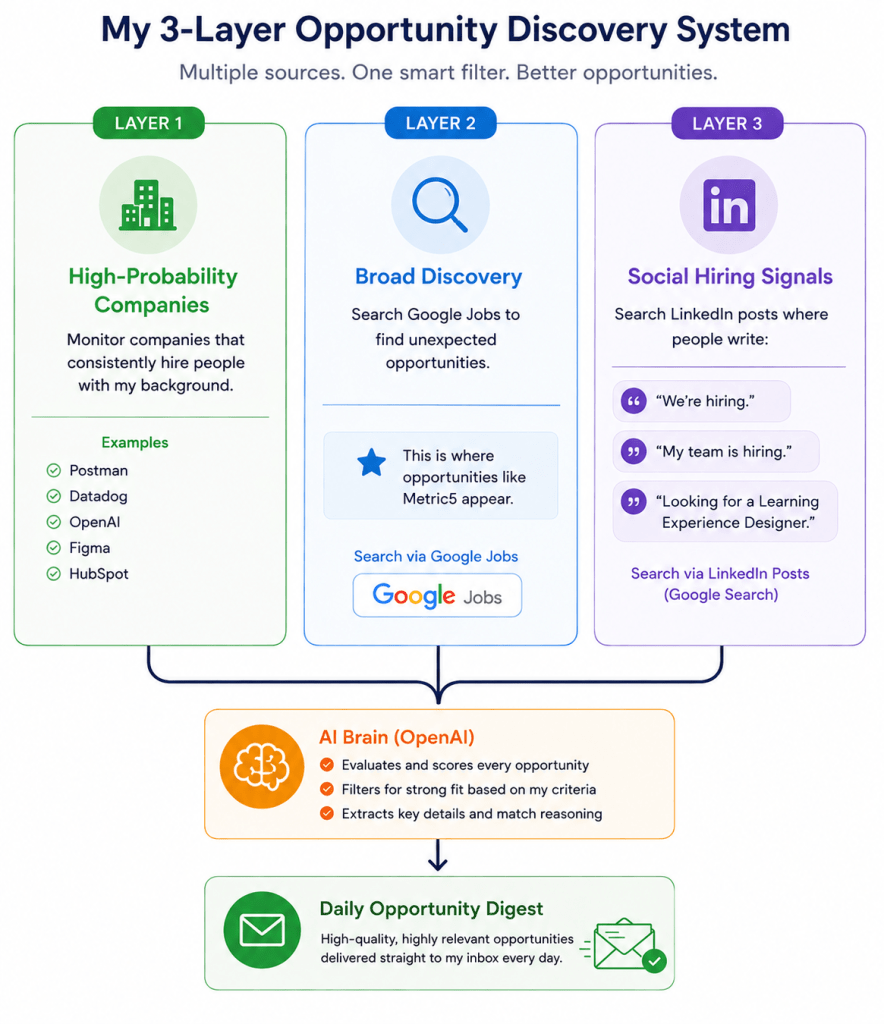
Layer 1: High-probability companies
Monitor companies that consistently hire people with my background.
Layer 2: Broad discovery
Search Google Jobs to find unexpected opportunities.
This is where opportunities like Metric5 appear.
Layer 3: Social hiring signals
Search LinkedIn posts where people write:
“We’re hiring.”
“My team is hiring.”
“Looking for a Learning Experience Designer.”
These opportunities are often discovered before they even hit formal job boards.
All three layers will eventually feed into a single AI brain.
The AI will:
- Score opportunities
- Reject poor fits
- Identify recruiters
- Suggest networking strategies
- Send one daily email digest
Final Thoughts
The funny thing is, I still don’t have an AI career agent yet. I’m in the process of prototyping version two with my 3-layered system.
However, what I do have is a failed but not truly a failure Adzuna experiment, a handful of diagrams, and a notebook full of ideas that completely changed halfway through the process. But that’s exactly what prototyping is supposed to look like.
This project reminded me that the first version of a system isn’t meant to solve the problem. It’s meant to teach you where the problem actually lives.
And in this case, it wasn’t job searching at all. It was information discovery.
As learning professionals, we spend our careers designing experiences that help people find the right information at the right time so they can make better decisions. This project was simply an opportunity to apply those same principles to my own career.
The AI didn’t teach me how to find a job. It taught me how to think differently about finding one.
And honestly, that may end up being the most valuable outcome of the entire experiment.


Leave a comment